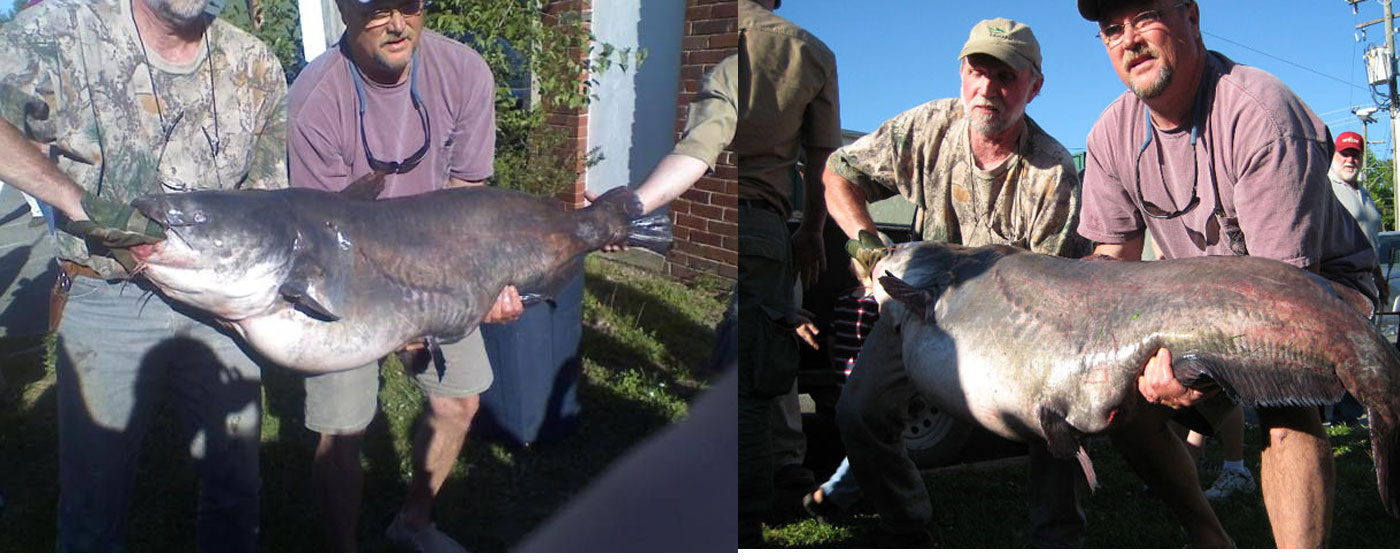
The blue catfish population continuing to expand, both in numbers and in size, enhances the possibility of your catch of a lifetime.
See More Details...
Gill Net (Page 2 of 2)
Here is a video off of YouTube that has Dan Szajta in it. He's a guide on the James River
This video shows a gill net already out and being taken back in after soaking for a while. Some people will get confused about the floats across the top of the net. Some nets have the floats and some nets have a float line rather than a float every 12-18 inches.
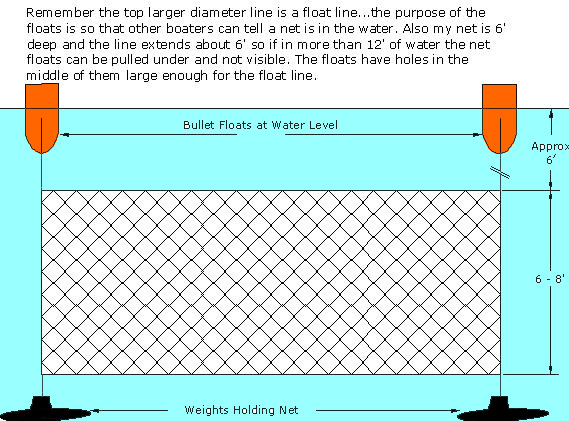
Both have advantages and disadvantages. I use the net with out the floats across the top and that's what Fishnet sells that I have listed. 2 advantages is it takes less room in a bucket or tub and you can adjust the floats on each end by adding an extension to the float line so the net can be used in deeper water if the bait fish are deep rather than shallow. With floats across the top every 12-18 inches that would be unpractical to try.
The one advantage of the net with floats would be less chance of a large fish taking the net under.
One thing I might mention I also put the shad in a 5 gallon bucket lined with a 30 gallon trash bag as they come out the net. When I have enough shad I just pick up the bag and place in the cooler on ice. That keeps the shad off the melting ice and water and also makes it much easier to clean the cooler.
Note:
Legal Gill Net year round
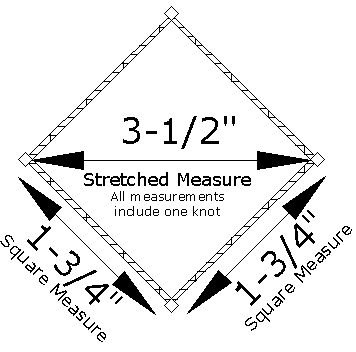
1-3/4" Mesh 3 1/2" Stretch,
110 Feet Max Length
I just wrapped a rope around the middle section about 4 times and tied a knot with about 2 feet left over....then tied a a looped knot on the other end. I tied a looped knot in the weighted net line and ran the shackle through both loops. So now if I need to take the weight off.....no problem.
 Ok here's where the user of the net has to use discretion in the time the net is in the water or the term used "soak". Many times a guide will let a net soak 15 - 20 minutes, but you have to remember he may have 2, 3, or even 4 clients, sometimes a second boat for the day. When putting out the net, a mouth of some creek right off of A flat can be a good place. Just start dropping it around 4 to 5 feet of water then back your boat up straight. When you drop off your other end hold the LEAD line & the float rope some what tight Then drop the LEAD LINE then pull the float rope tight, taking rest of the slack out. At this point a suggestion is made to hold on to the float line/rope.....then you can feel when the shad are hitting. When the net is pulled in try to position the boat so that the current is pushing the boat away from the net, therefore keeping the boat a safe distance away as not to get the net tangled in the boat.
If you don't hold on to the float rope....watch for the float rope jumping then go pull it in. Don't let it soak over 5-10 minutes before checking.....when shad are thick 5 minutes could be long enough. If you feel the shad hitting the net as you let it out.....you may need to pull it back in as soon as you have it out. Regulations state you must stay with in 100 yards of the net if you do decide not to hold on to the float rope.
Another caution......that you must keep in mind .....is the gill net is set up basically for shallow water from the above illustration...most of the floats will not keep the net a float with 5 pound weights on each end ....if you get in much over 12 feet of water depending on how the weights were attached. But to save confussion the net will float if no weights were added....the weights keep the net in place and also I have found many times the shad are on or near the bottom.Best Fishing For Blue Catfish In The State
![[image]](picts/fshpk.jpg)
It may be a good idea to use gloves when handling shad in the gillnet while you are learning. The first time my hand's got pricked pretty bad. A fish pick helps BIG TIME in getting them out. The Fish Net company has them for about 3 bucks - they're really just a hook with a handle to help you get hold of the net and pull it off.
It is a bit of a problem getting them out of a 4" net. On the smaller ones shad you can just grab them by the head (stick you thumb in the gill for grip) and pull the through the net head first. The bigger shad often have to be backed out which is where the pick helps.
Thought I would mention this...we had a guy from this area that was fishing the James a couple of years ago. He was using a gill net and just had it laying on the deck of the boat as he let it out. His feet got tangled up in it and pulled him off the boat. He could not get his feet loose in the water and if his fishing buddy wasn't with him that day he would have drowned. This was in the winter and they were close to the truck to change clothes.
With that in mind I would think using some type of a container to let the net out....would be a wise and safe thing to do...instead of having it loose.
<Another report a couple of years ago , a catfisherman got tangled in his anchor rope during the winter months as he was throwing out the anchor, got him off balance, and in the water he went. He was able to get back in the boat quick. Luckily he didn't have his cell phone on him but in the boat and was near the ramp. He lived in the area and his wife met him at the ramp with dry clothes.
.
Two more incidents this summer where experienced fisherman fell out the boat leaning over to far trying to land a fish in the net. One of these guys had been fishing for over 20 years and never fell out of the boat and was a good swimmer. He was able to get back in the boat in a couple minutes. However on the other overboard fisherman that was just below Jordan Point, rescue had to be called. The current swept him away and it was several hours before getting back to the boat...good thing it was summer time.
With that said, things can happen, Safety First....
Safety First -- Winter Months Catfishing from a boat --
An Average of less than 15 minutes to get out of the 32? Water If you fall in.... ...
Catfishing is year round enjoyment but prime time are the winter months, especially from the end of November through February. Catfish are in their winter pattern and many times found stacked in deep holes. During this time of the year hypothermia is a concern and should be given much thought for fisherman's safety.
The weather can be frigid with the air and water temperature dropping and always the wind chill factor to consider. Wind may be another factor as far as staying dry, depending on the type of boat and water. On the James with areas of big water at Hopewell and downriver it's very important to know what the wind is doing. Some boats have more spray than others and you don't want to be wet.
Although there are heavy insulated coveralls and coats on the market most recommend to dress in layers. The basic thermal undergarments are a good start, as they will also wick moisture from the skin. Polypropylene is the thickest thermal material available. Staying dry is top priority in cold weather, pure cotton will retain moisture. Several poly blend sweat shirts and jeans for the next layers and top it off with a layer of water resistant clothing such as Gore-tech. On those extremely cold and windy days I will also use a PVC rain coat before putting on the top layer....this always keeps my chest and shoulders warm in extreme conditions.
As far as head gear, a large percentage of body heat is lost through your head and a ball cap is not enough in winter months. A silk balaclava is what I use. It's thin so I can have layers on my head also. The second layer I use a wool beanie and sometimes wear a cap over both. If it's extremely cold or traveling the river in the boat I will protect my lungs by pulling the balaclava up over my mouth. Often mittens are recommended as they offer more warmth than gloves because your fingers can touch each other and give off more heat. Always keep spare gloves on board. It's easy to get the gloves wet before thinking.
When choosing a boot it needs to be waterproof and insulated and one that has good traction, don't want to slip and fall out the boat. Another thing to look for is thick-soled boots to help keep your feet warm. Pick a size that will allow for thick socks. Keep your feet warm and dry, feet are the first to loose feeling in the cold. Your survival may depend on a PFD in cold water, weather it be the vest or inflating type, if falling out of the boat. Try to find somewhere on the boat to carry a spare set of clothes and shoes. The tidal James is a highly productive system, and as long as the forage -- primarily gizzard shad -- holds out we will continue to see the size structure for blue cat catches expand upward, topping the 100-pound mark.
As the popularity of gills nets increase rapidly there are some concerns that the bait fish (Shad) my be depleted at a point that regulations could be implemented, that is if any reports indicate a sharp decrease in the Shad population. Respecting the gill net and its ability to catch large amounts of bait should be on our minds, because sooner or later there will be more shad in the net than you can use. At that time you are wasting valuable fishing time clearing the net and trying to find other fisherman to take the unneeded shad.
So especially us that are "just-learning" please respect the net and do your best not to waste. While we enjoy the great fishing we have and the freedoms, we need to make sure we take care of our fishery. Most everyone is releasing the catfish unharmed and thus securing the fishing for years to come. Lets work together to make sure we take care of our bait too, in order to secure our continued freedom to use a gill net.
In reviewing my records I find before day break and the last 2 hours of outgoing tide is the very best time to catch bait but not always able to catch that combination. My understanding shad will be deeper after sun rise. During the day, it's much easier to catch bait the last 2 hours of outgoing tide, on high tide the bait is scattered.